Goldmund carves the Mariabronn refectory lectern
Narcissus and GoldmundGoldmund carves the Mariabronn refectory lectern as his first major work after returning to the monastery, shaping an unornamented reading niche into a sculptural account of creation. Its spiral staircase, plants, animals, patriarchs, and apostles bring the natural world and religious teaching into one ordered design. Over two years, the work becomes both a practical gift to the cloister and a defining expression of Goldmund’s artistic vocation; when Narcissus sees one of its figures, he recognizes not only Abbot Daniel but also the friend whose inner life he had never fully understood.
Setting and Purpose
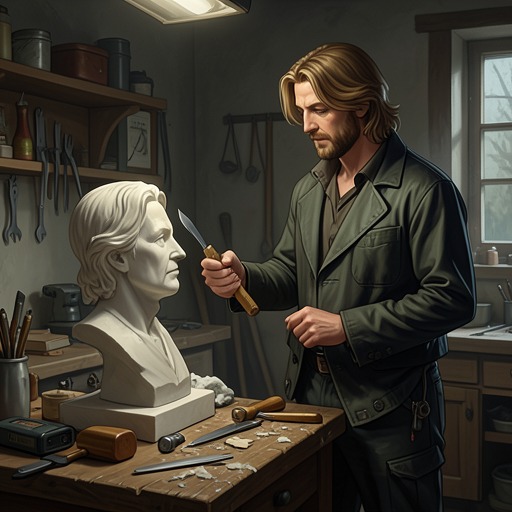
After returning to Mariabronn, Goldmund found a suitable workshop in an empty shed beside the courtyard gate. He ordered a drawing board and tools, drew up plans, arranged for materials to be brought from nearby cities, selected timber, and built a roof over the wood he had set aside to dry. Erich, the blacksmith’s son, helped him make the knives, chisels, drills, and planes his work required, and became his friend and assistant.
Goldmund wanted his first work for the cloister to belong to its architecture and daily life, rather than to be an unrelated object displayed merely for its novelty. An altar or pulpit would have suited his ambitions, but neither was needed or available. In the refectory he found a raised niche where a young brother read passages from the lives of the saints during meals. Because the niche was undecorated, Goldmund proposed carved panels for its steps and lectern, with figures in half-relief and others standing almost free of the wood. The Abbot approved the plan.
The choice of a reading place gave the commission a particular function: the carving would accompany communal meals and the reading of saints’ lives. Goldmund imagined the work not as an isolated sculpture but as part of the cloister’s fabric, joining its religious use to the surrounding architecture.
Design and Making
Goldmund conceived the work in two parts: one representing the world, the other the word of God. The lower structure was a staircase winding around a sturdy oak trunk, its rising steps to carry images of creation, nature, and the simple lives of the patriarchs and prophets. Above it, the parapet would show the four apostles. Their identities would also carry personal memory: one evangelist would bear the traits of Abbot Daniel, another those of Father Martin, his successor, and Luke those of Master Niklaus, Goldmund’s former teacher.
The design’s paired levels gave the lectern a legible upward movement, from the created world at its base to the apostles above. In execution, however, its lower portion became more than a collection of illustrative scenes. A small, lively world grew from the thick spiral of the stairs: plants, animals, people, and Noah among grape leaves and grapes. The resulting work was described as a picture book praising the creation and its beauty, freely expressed yet held together by an inner order and discipline.
Goldmund began only after the snow had fallen and Christmas had passed. Once work was underway, he seemed to withdraw from the ordinary routines of the cloister. He took his meals at the mill, allowed only Erich into the workshop, and sometimes worked in silence even when his assistant was present. He pursued the carving with alternating enchantment and discouragement, treating each difficulty as a demand that could teach him greater sensitivity. The work absorbed him so completely that he nearly forgot both the monastery and Narcissus.
Erich’s role grew alongside the carving. At first he was the only person allowed to see the developing work and was entrusted with small tasks; he hoped to become an artist himself. In the second year, he was formally given to Goldmund as an apprentice. Goldmund was pleased to have a committed learner, and, if the work succeeded, considered asking Erich’s father to release him for permanent training as his assistant.
Figures and Relationships
The evangelists gave the design a way to hold relationships and memories within a religious ensemble. Goldmund’s most successful figure, in his own judgment, was the one modeled on Abbot Daniel. He loved it for the kindness and purity of its face. By contrast, the figure bearing Master Niklaus’s traits seemed to Goldmund less successful: it expressed discord and sadness, lofty creative ambition alongside awareness of the limits of creation, and grief for a lost unity and innocence. Erich admired this more troubled figure most of all, while Goldmund’s own affection rested especially on Abbot Daniel’s image.
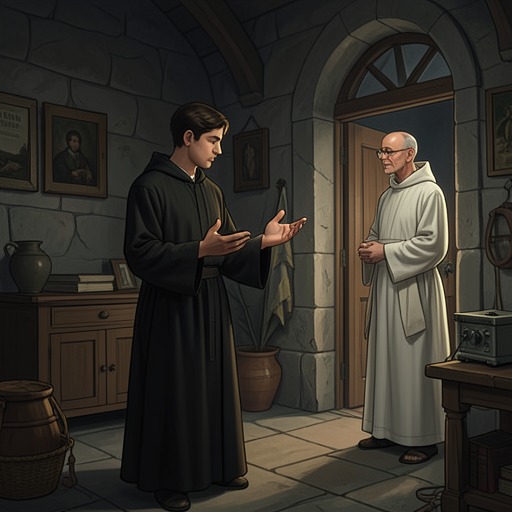
Goldmund revealed the finished figure of Abbot Daniel to Narcissus before showing him the rest. He waited until his friend was available, then brought him to see the statue. Narcissus immediately recognized their former Abbot in the evangelist, but he also saw in the carving the dignity, kindness, and simplicity associated with their earlier years. He told Goldmund that the figure had restored Abbot Daniel to him and that, through the work, Goldmund had opened himself to Narcissus for the first time. The response transformed the viewing from an assessment of skill into an act of recognition between friends.
Their exchange also altered Narcissus’s view of art. He acknowledged that he had once regarded artistic work as less serious than thinking and science, because he had understood the senses as a pull toward the transitory and the mind as the route to the eternal. Goldmund’s work helped him recognize that knowledge has more than one path, and that the path of the mind is not necessarily the best one. Narcissus continued to regard intellectual life as his own way, but no longer treated it as the only serious way of knowing.
Completion and Significance
Goldmund worked on the group for two years. The carved balustrade became a small paradise, with a luxuriant wilderness of trees, brush, and herbs, birds in the branches, and animal heads and bodies appearing among the growth. Scenes from the patriarchs’ lives occupied this fertile setting. When restlessness or boredom interrupted his work, Goldmund sometimes gave Erich a task and left for a day or two to walk in the countryside or return to the remembered freedom of the forest. He then came back to the workshop and resumed carving with renewed concentration. Narcissus often visited, and the workshop became one of his favorite places in the cloister.
Several weeks after the larger work was finished, it was installed in its place. As in earlier experience, the completed work passed into public possession: people looked at it, judged it, and praised it, while Goldmund found his workshop and heart empty and wondered whether the sacrifice had been worthwhile. At the unveiling, he was invited to the fathers’ table for a festive meal, where the oldest wine in the house was served. He enjoyed the meal, but the interest and pleasure Narcissus took in the work mattered more to him than its public honor.
The lectern’s importance lies in the way it unites functions that Goldmund’s life had often kept apart. It serves a communal religious setting while preserving the visible richness of plants, animals, and human life; its natural imagery rises through a disciplined structure toward the apostles. Its figures also carry personal histories into the cloister, making artistic creation a form of remembrance. Finally, Narcissus’s response marks a change in their friendship: the work lets him encounter Goldmund not as a subject to be explained by reason, but as an artist whose way of making reveals knowledge and feeling that argument alone had not reached.